FOUNDATIONAL DOCUMENTS
1215 – Magna Carta
1776 – Declaration of Independence
1787/1789 – Constitution
1801 – Cane Ridge Revival
1804 – Last Will and Testament of the Springfield Presbytery
1807 – Thomas Campbell arrived
1809 – Declaration and Address
1809 – Alexander Campbell arrived
1/1/1832 – The Stone and Campbell movements unite
Stone and Campbell were not out to “restore the true church,” as if it did not already exist. Their intention was to restore to the church (that already existed) things they believed lacking. They were reformers, desiring to change conditions that were amiss. They understood that the Body of Christ has always existed, just as Jesus promised that it would, but that it always needs reforming—even as it did in the first century, and even as it does today!
It was at the outset intended to be only a Movement, a movement “to unite the Christians in all the sects.” … Their idea was to work within the existing churches, for there the true Body of Christ was present amidst all the sectism, and thus to help the task of reformation that began with Luther. The first congregations under Stone attempted to work within the Presbyterian framework, and Campbell’s first church (Brush Run) joined two different Baptist associations.
None of this worked. They found themselves on the “outside” (so to speak) and so they evolved into a society of their own. By 1850 they were upwards of one-half million strong, calling themselves “Christians” and “Disciples,” but hardly ever “Church of Christ.” And at this time they were quite different from what we now call the “Church of Christ.” The main difference is that they were not exclusivists nor sectarians, for they generally practiced the rule laid down by Campbell that nothing is to be made a test of fellowship but what is clearly set forth in the scriptures, and they readily conceded that they were not the only Christians, though they did take pride in being Christians only.
Other slogans:
· "Where the Scriptures speak, we speak; where the Scriptures are silent, we are silent."
· "The church of Jesus Christ on earth is essentially, intentionally, and constitutionally one."
· "We are Christians only, but not the only Christians."
· "In essentials, unity; in opinions, liberty; in all things love."
· "Call Bible things by Bible names."
An orthodox “Church of Christ” member of the 1970’s would have been uncomfortable in the Disciple congregations of the 1850’s. He would have as fellow-members oodles of Baptists that came into the Movement without being re-immersed. He would sorely miss the claim that “We are the only true church,” for they did not believe that. … as he moved among the congregations he might not see a single sign reading “Church of Christ.” … Nor was there then the demand for conformity as there is now among us. They had widely divergent views on many points of doctrine, including baptism. Thomas Campbell was an avowed Calvinist and Barton Stone had unorthodox views on the preexistence of Christ. But their broader view of fellowship kept them one people. Alexander Campbell was a post-millennialist; Barton Stone was a pre-millennialist. (365,000 years)
… It all came to a head in Sand Creek, Illinois on August 17, 1889 [Address & Declaration]
[That’s for another class… maybe!]
If needed –
Postmillennialism expects Christ to return after the millennium, which usually is to come through the preaching of the gospel. This outlook is optimistic (the world will be converted), not particularly mission-minded (God will work it out in His own time) and is unspectacular enough not to attract special attention.
Premillennialism looks for Christ to return before the millennium and to bring it about, saving man from his own destruction in the process. It is generally pessimistic (the world is getting worse every day; only Christ can save it), often is very mission-minded (not much time is left), and is frequently associated with spectacular announcements and movements (this all will come through climactic, supernatural events when least expected by mankind).
1/1/1832 –
Raccoon was well aware
of the responsibility he bore in such a sensitive setting, that the least
uncharitable gesture or the slightest sectarian remark could arouse suspicion
and prejudice and blast the hope of union at the very hour it was budding into
reality. He drew his remarks from Jesus’ prayer for unity in John 17, that it
is both desirable and practical, and that if our Lord prayed such a prayer it
can be realized. In distinguishing between faith and opinion, which alluded to
differences between them, he said there are a thousand opinions but one faith,
ad that we can never unite on opinions but only upon the one faith which
centers in Christ. He noted that when opinions and speculations are made tests
of fellowship it always causes division. He said he personally avoided
speculative theories by simply letting the Scriptures speak for themselves. We
unite upon one faith, not one opinion, he insisted.
He at last made that great plea that is reflective of one of the Movement’s
greatest hours, “Let us then, my brethren, be no longer Stoneites or
Campbellites, or New Lights or Old Lights, but let us all come to the Bible,
and to the Bible alone, as the only book in the world which can give us all the
light we need.”
Which are we today?
- “New Lights” emphasized the need for a conversion experience that was considered a sign of a new heart.
- “Old Lights” emphasized for the communication of correct doctrines and personal piety.
RESTORATION MOVEMENT TIMELINE
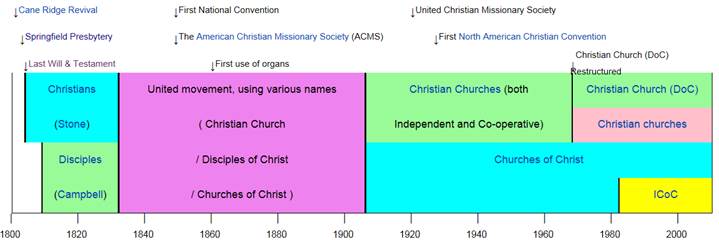
Last Will and Testament of the Springfield Presbytery
June 28, 1804
For where a testament is, there must of necessity be the death of the testator; for a testament is of force after men are dead, otherwise it is of no strength at all, while the testator liveth. Thou fool, that which thou sowest is not quickened except it die. Verily, verily, I say unto you, except a corn of wheat fall into the ground, and die, it abideth alone; but if it die, it bringeth forth much fruit. Whose voice then shook the earth; but now he hath promised saying, yet once more I shake not the earth only, but also heaven. And this word, yet once more, signifies the removing of those things that are shaken as of things that are made, that those things which can not be shaken may remain.—Scripture
The Presbytery of Springfield sitting at Caneridge, in the county
of Bourbon, being, through a gracious Providence, in more than ordinary bodily
health, growing in strength and size daily; and in perfect soundness and
composure of mind; but knowing that it is appointed for all delegated bodies
once to die; and considering that the life of every such body is very
uncertain, do make and ordain this our last Will and Testament, in manner and
form following, viz.:
Imprimis. We will, that this body die, be dissolved, and sink into union with the Body of Christ at large; for there is but one body, and one Spirit, even as we are called in one hope of our calling.
Item. We will that our name of distinction, with its Reverend title, be forgotten, that there be but one Lord over God's heritage, and his name one.
Item. We will, that our power of making laws for the government of the church, and executing them by delegated authority, forever cease; that the people may have free course to the Bible, and adopt the law of the Spirit of life in Christ Jesus.
Item. We will, that candidates for the Gospel ministry henceforth study the Holy Scriptures with fervent prayer, and obtain license from God to preach the simple Gospel, with the Holy Ghost sent down from heaven, without any mixture of philosophy, vain deceit, traditions of men, or the rudiments of the world. And let none henceforth take this honor to himself, but he that is called of God, as was Aaron.
Item. We will, that the church of Christ resume her native right of internal government,—try her candidates for the ministry, as to their soundness in the faith, acquaintance with experimental religion, gravity and aptness to teach; and admit no other proof of their authority but Christ speaking in them. We will, that the church of Christ look up to the Lord of the harvest to send forth laborers into his harvest; and that she resume her primitive right of trying those who say they are apostles, and are not.
Item. We will, that each particular church, as a body, actuated by the same spirit, choose her own preacher, and support him by a free-will offering, without a written call or subscription—admit members—remove offenses; and never henceforth delegate her right of government to any man or set of men whatever.
Item. We will, that the people henceforth take the Bible as the only sure guide to heaven; and as many as are offended with other books, which stand in competition with it, may cast them into the fire if they choose; for it is better to enter into life having one book, than having many to be cast into hell.
Item. We will, that preachers and people cultivate a spirit of mutual forbearance; pray more and dispute less; and while they behold the signs of the times, look up, and confidently expect that redemption draweth nigh.
Item. We will, that our weak brethren, who may have been wishing to make the Presbytery of Springfield their king, and wot not what is now become of it, betake themselves to the Rock of Ages, and follow Jesus for the future.
Item. We will, the Synod of Kentucky examine every member who may be suspected of having departed from the Confession of Faith, and suspend every such suspected heretic immediately, in order that the oppressed may go free, and taste the sweets of Gospel liberty.
Item. We will, that Ja---------, the author of two letters lately published in Lexington, be encouraged in his zeal to destroy partyism. We will, moreover, that our past conduct be examined into by all who may have correct information; but let foreigners beware of speaking evil of things which they know not.
Item. Finally we will, that all our sister bodies read their Bibles carefully, that they may see their fate there determined, and prepare for death before it is too late.
|
Springfield
Presbytery, |
|
(L.S.) |

|
Robert
Marshall, |
|
Witnesses. |

The Witnesses' Address
We, the above named witnesses of the Last Will and Testament of the Springfield Presbytery, knowing that there will be many conjectures respecting the causes which have occasioned the dissolution of that body, think proper to testify, that from its first existence it was knit together in love, lived in peace and concord, and died a voluntary and happy death.
Their reasons for dissolving that body were the following: With deep concern they viewed the divisions, and party spirit among professing Christians, principally owing to the adoption of human creeds and forms of government. While they were united under the name of a Presbytery, they endeavored to cultivate a spirit of love and unity with all Christians; but found it extremely difficult to suppress the idea that they themselves were a party separate from others. This difficulty increased in proportion to their success in the ministry. Jealousies were excited in the minds of other denominations; and a temptation was laid before those who were connected with the various parties, to view them in the same light. At their last meeting they undertook to prepare for the press a piece entitled Observations on Church Government, in which the world will see the beautiful simplicity of Christian church government, stript of human inventions and lordly traditions. As they proceeded in the investigation of that subject, they soon found that there was neither precept nor example in the New Testament for such confederacies as modern Church Sessions, Presbyteries, Synods, General Assemblies, etc. Hence they concluded, that while they continued in the connection in which they then stood, they were off the foundation of the Apostles and Prophets, of which Christ himself is the chief corner stone. However just, therefore, their views of church government might have been, they would have gone out under the name and sanction of a self-constituted body. Therefore, from a principle of love to Christians of every name, the precious cause of Jesus, and dying sinners who are kept from the Lord by the existence of sects and parties in the church, they have cheerfully consented to retire from the din and fury of conflicting parties--sink out of the view of fleshly minds, and die the death. They believe their death will be great gain to the world. But though dead, as above, and stript of their mortal frame, which only served to keep them too near the confines of Egyptian bondage, they yet live and speak in the land of gospel liberty; they blow the trumpet of jubilee, and willingly devote themselves to the help of the Lord against the mighty. They will aid the brethren, by their counsel, when required; assist in ordaining elders, or pastors--seek the divine blessing--unite with all Christians--commune together, and strengthen each other’s' hands in the work of the Lord.
We design, by the grace of God to continue in the exercise of those functions, which belong to us as ministers of the gospel, confidently trusting in the Lord, that he will be with us. We candidly acknowledge, that in some things we may err, through human infirmity; but he will correct our wanderings, and preserve his church. Let all Christians join with us, in crying to God day and night, to remove the obstacles which stand in the way of his work, and give him no rest till he make Jerusalem a praise in the earth. We heartily unite with our Christian brethren of every name, in thanksgiving to God for the display of his goodness in the glorious work he is carrying on in our Western country, which we hope will terminate in the universal spread of the gospel, and the unity of the church.
Thomas Campbell’s
DECLARATION & ADDRESS
1809
Three versions follow, beginning on the next page:
#1 – 2008
#2 – 1976
#3 – 1809
Amongst Christians there is now, as there was at the beginning a very great diversity in the knowledge of the Christian institution. There are babes, children, young men, and fathers in Christ now, as well as in the days of the Apostle John. This, from the natural gifts of God, from the diversities of age, education, and circumstances, is unavoidable. And would it not be just as rational and as scriptural to excommunicate one another, because our knowledge is less or greater than any fixed measure, as for differences of opinion or matters of speculation?
Indeed, in most cases where proscription and exclusions now occur in this country, the excluded are the most intelligent members of the society; and although no community will accuse a man because he knows more of his Bible than his brethren, and on this account exclude him from their communion; yet this, it is manifest, rather than heresy, (of which, however, for consistency’s sake, he must be accused,) is, in truth, the real cause of separation.
If God has bestowed better gifts or better opportunities on one man than another, by which he has attained more knowledge, instead of thanking God for his kindness to the community, they beg God to take him away; and if he will not be so unkind, they will at length put him from among them under the charge of heresy. In most instances the greatest error of which a brother can be guilty, is to study his Bible more than his companions—or, at least, to surpass them in his knowledge of the mystery of Christ.
Alexander Campbell,
To Mr. William Jones, of London, Letter IV,
Millennial Harbinger 6, no. 3 (March 1835): 112.
2008 Version – Doug Foster
Introduction
The following propositions are by no means intended to be a creed or something to be imposed on believers—nothing could be further from the truth. They are designed, rather, to focus our hearts and minds on the great question of what it means to be followers of Christ. Too often we seem to have forgotten what is central to our identity as Christians and as Christ's church. It is our hope that these ideas will stimulate serious consideration of who we are and who we ought to be.
Christ established one church—just one. This church is made up of everyone who has faith in Christ and is trying to follow him in the ways God's Spirit in scripture has told us, and who others can see are being transformed into his likeness by the way they act. No one else has a right to be called a Christian.
Proposition 2
It is physically impossible for all Christians to be together in one place to worship and work, so there have to be local groups of Christians that reflect the culture, language, and context of each place. These groups will not all look, think, or act alike, yet they are all part of Christ's church and ought to recognize it. They must accept and embrace each other just as Christ has accepted each of us. This will happen when Christians have the mind of Christ—that is, when they are willing to give themselves for those Christ died to redeem. This is the rule of Christ. This and this alone will join them perfectly.
Proposition 3
Therefore, nothing should be required to recognize, fellowship, embrace, work, worship, and be fully and visibly united with all Christians that is not specifically made a requirement by God in his word. Nothing should be required in the way local bodies of Christians operate that is not specifically required by Christ and his Apostles for the church. Furthermore, the chief requirements for full fellowship that God has decreed are our love for God and for people. This love is formed by our understanding of God's love for us shown through Christ.
Proposition 4
Both the Old and New Testaments are essential parts of the revelation of God's nature and work. They cannot be separated. While it is true that the practices required in the Old Testament (sacrifices, temple worship, priesthood, etc.) are not in force for Christians and that the good news of God's saving work is found fully in the New Testament, both testaments teach us about God's nature and work. The Bible is not primarily a constitution that functions as a legal document to consult in legal disputes. It is, instead, the sword of the Spirit; it is a place where we encounter God's Spirit and are transformed increasingly into the likeness of Christ. Attending to scripture is essential to the visible unity of Christ's church.
The Bible does not spell out in detail everything Christians are supposed to think, do or be—that is just not the nature of scripture. When there are specific actions Christians are told to take, there is almost never a set of detailed requirements for how to do it. Humans often want more detail and try to expand on the specifics, often making them requirements for accepting other Christians or groups of Christians. That is wrong. Again, Christians are those who say they are Christians and who show that they are by the way they live. No one should be allowed to require anything for recognition and fellowship that is outside of scripture and its work of transformation.
Proposition 6
God gave us our ability to think and reason—that is a good thing. If, however, in the process of using our reason we come to conclusions that other Christians do not reach, and that causes us to reject them, we have been deceived by the evil one. Our pride has taken over and stopped our continued growth into the mind of Christ—a mind of complete humility and self-sacrifice. Human reason is not the ultimate standard for truth. Christians ought to be growing constantly in their understanding of the profound truths of the gospel—that's part of our spiritual growth as communities. But requiring or even expecting others to be where you are is not conducive to the visible unity Christ so much wants.
Proposition 7
Again, it is a good thing to use the intellectual abilities God has given us to plumb the depths of the marvelous truths of God. It is a good thing to think, and struggle and write about these matters. Individual Christians and Christian communities can and should draw great benefit in their spiritual growth from such efforts. Statements of belief can be very helpful in drawing our minds to the unspeakable riches and blessings we have been given and of which we can and should tell others. However, we must realize that such statements are the product of our human reasoning which, like everything else human, is not perfect. Even when we reach a mature level of doctrinal understanding, we need to remind ourselves constantly that there will always be Christians at all maturity levels—but they are still all Christians!
Proposition 8
Once again, having an understanding of every Christian truth is not a requirement to be a Christian, a part of Christ's church. No one who is trying to follow Christ ought to be forced to confess any belief beyond what they understand and know. All a person needs to know to be part of Christ's church is that they are lost and that salvation is through Christ. When they confess that they believe in Christ and that they want to obey him fully according to his word—nothing else can be required.
Proposition 9
Everyone who confesses belief in Christ and commits to obey him, and who shows the reality of their commitment by the way they live, should consider each other as the precious saints of God, should love each other as sisters and brothers, children of the same family and Father, temples of the same Spirit, members of the same body, subjects of the same grace, objects of the same divine love bought with the same price, and joint heirs of the same inheritance. Whoever God has joined together this way, no one should dare divide.
Proposition 10
Division among Christians is a sickening evil, filled with many evils. It is anti-Christian because it destroys the visible unity of the body of Christ. It is as if Christ were cutting off parts of himself and throwing them away from the rest of his body! What a ludicrous picture! Division is anti-scriptural, since Christ himself specifically prohibited it, making it a direct violation of Christ's will. It is anti-natural, because it makes Christians condemn, hate and oppose one another—people who are actually obligated in the strongest way to love each other as sisters and brothers, just like Christ loved them. In other words, division repudiates everything Christianity is supposed to stand for.
Two things are responsible for all the divisions and corruptions in Christ's church through the centuries. One is a neglect or even fundamental misunderstanding of God's will for us in scripture—that we have the mind of Christ and be transformed into his likeness. The other comes from the first. Some Christians, assuming they are "right," that they have gotten the "facts" perfectly, have assumed the authority to impose their conclusions on others as terms of recognition and fellowship.
Proposition 12
In reality, everything needed for the church to reach the highest state of perfection and purity on earth is first to receive as members only those who have understood their lostness and confessed their faith in Christ and commitment to follow him according to scripture; second, to keep as members only those who show those commitments in their everyday lives; and third, to see that ministers who reflect these ideals, preach only what is clearly taught in scripture. Finally, they must stick close to what scripture makes primary, seen in the example of the early church in the New Testament, without being distracted or corrupted by human tendencies toward pride and control.
Proposition 13
Finally, in every body of Christians decisions must be made about precisely how to conduct its work and worship. Scripture does not dictate such details. Whatever the best way of doing things for the local context should be adopted. These procedures, however, should always be understood as expedients or conveniences for that time and place. Others who do things differently should never be denigrated or condemned for such things, and when decisions are made to do things differently in the future, such changes should never be an issue of fighting or division.
1976 Version – Knofel Staton
Here are thirteen propositions that we think can help us stand on the same ground as the church in the New Testament.
1. The Church of Christ on earth is indispensably, intentionally, and structurally one. It includes everyone in any place who professes trust and obedience to Christ in all matters according to the Scriptures; and who demonstrates such in character and conduct. No one else can be called a Christian.
2. Although the Church of Christ on earth exists in different locations, there should be no divisions among congregations. Each congregation should receive the other as Christ Jesus has. That would manifest God's character before all. To facilitate this, all congregations should observe the same practices and speak the same principles.
3. In order to carry this out, nothing should be forced upon Christians except what is clearly taught in the Word of God. Nothing should be treated in the constitution and by-laws as divine authority unless it is clearly taught in the Word of God. Thus human traditions, regardless of "how long we've done it that way," cannot be our authority. [8]
4. Although God's revealed will is expressed in both the Old and New Testament books, the New Testament books contain the immediate constitution for the worship, discipline, and government of the corporate Church and for the duties of the individual members.
5. Nothing ought to be received into the beliefs and worship of the Church nor made the test for fellowship which is not as old as the New Testament books.
No one should dictate binding directives outlining exactly how procedures have to be carried out if the New Testament is silent about such procedures.
It is enough if we fulfill the intent of those practices where procedures are not clearly spelled out.
6. The "conclusions" we arrive at from systematic Scriptural study, as doctrinally valid and valuable as they may be, should not be used as tests of fellowship. "Conclusions" result from our reasoning endeavors. But a man's faith must stand upon the power and truth of God, not in the wisdom of men.
Our "conclusions" should be used for building up those who are already Christians, not for admittance exams to those who are not.
7. Our "conclusions" will certainly vary as we systematically study the many various topics within Christianity. The more comprehensibly we study and communicate a topic, the better.
However, let us realize that the Church is made up of all levels of spiritual maturity--and understanding--spiritual babes, spiritual adolescents, spiritual young adults, spiritual adults (figuratively speaking). That means we will always have differences in our understandings and thus in our conclusions. But these differences should not be used as tests of fellowship.
8. It is not necessary that people see all God's truth exactly alike before they are added to His Church. What is necessary is that they recognize two things: (1) their lost condition and (2) Jesus' way of salvation. And then declare their faith in Him and their willingness to obey Him in all things.
9. Anyone who has made such a declaration should consider anyone else who has made such an acknowledgement as saints of God and should love such as brothers. For such people are children of the same family, temples of the same Spirit, members of the same body, subjects of the same grace, objects of the same Divine love, bought with the same price, and joint-heirs of the same inheritance. And whom God hath joined together no man should dare to put aside.
10. Division among Christians is a repulsive evil filled with many tragedies. Here are three of those tragedies:
(1) It is antichristian, because it destroys the visible unity of the body of Christ. Division suggests that Christ is divided against Himself by excluding and excommunicating a part of Himself. (2) It is antiscriptural, because it is strictly forbidden by God. (3) It is antinatural, because it motivates Christians to hate and oppose one another who are commanded by God to love one another as brothers.
In summary, divisions are a product of and produce confusion and every evil work.
11. All the past and present corruptions and divisions in the Church have resulted from two causes: (1) The partial neglect of the clearly expressed will of God; (2) The insistence that human opinions and hobby horses be accepted in the belief, life, and worship of the Church.
12. There are four practices necessary if the Church is to manifest the maturity and manners God wants: (1) That no one be admitted who does not acknowledge faith in Christ and obedience to Him. (2) That no one be kept who doesn't back up that acknowledgement with character and conduct. (3) That properly qualified preachers teach nothing other than what is clearly expressed in the Word of God. (4) That those preachers observe all the [9] Divine ordinances which the Church in the New Testament books observed--in the way that the Church observed them.
13. When the observances of the ordinances are altered due to circumstances and the alteration is essential or the observance would not have been possible (due to the circumstances) then that alteration must be seen as an human expedient only. No higher sanction can be given to it.
1809 Version – Thomas Campbell
PROP. 1. THAT the church of Christ upon earth is essentially, intentionally, and constitutionally one; consisting of all those in every place that profess their faith in Christ and obedience to him in all things according to the scriptures, and that manifest the same by their tempers and conduct, and of none else as none else can be truly and properly called christians.
2. That although the church of Christ upon earth must necessarily exist in particular and distinct societies, locally separate one from another; yet there ought to be no schisms, no uncharitable divisions among them. They ought to receive each other as Christ Jesus hath also received them to the glory of God. And for this purpose, they ought all to walk by the same rule, to mind and speak the same thing; and to be perfectly joined together in the same mind, and in the same judgment.
3. That in order to this, nothing ought to be inculcated upon christians as articles of faith; nor required of them as terms of communion; but what is expressly taught, and enjoined upon them, in the word of God. Nor ought any thing be admitted, as of divine obligation, in their church constitution and managements, but what is expressly enjoined by the authority of our Lord Jesus Christ and his Apostles upon the New Testament church; either in express terms, or by approven precedent.
4. That although the scriptures of the Old and New Testament are inseparably connected, making together but one perfect and entire revelation of the Divine will, for the edification and salvation of the church; and therefore in that respect cannot be separated; yet as to what directly and properly belongs to their immediate object, the New Testament is as perfect a constitution for the worship, discipline and government of the New Testament church, and as perfect a rule for the particular duties of its members; as the Old Testament was for the worship discipline and government of the Old Testament church, and the particular duties of its members.
5. That with respect to the commands and ordinances of our Lord Jesus Christ, where the scriptures are silent, as to the express time or manner of performance, if any such there be; no human authority has power to interfere, in order to supply the supposed deficiency, by making laws for the church; nor can any thing more be required of christians in such cases, but only that they so observe these commands and ordinances, as will evidently answer the declared and obvious end of their institution. Much less has any human authority power to impose new commands or ordinances upon the church, which our Lord Jesus Christ has not enjoined. Nothing ought to be received into the faith or worship of the church; or be made a term of communion amongst christians, that is not as old as the New Testament.
6. That although inferences and deductions from scripture premises, when fairly inferred, may be truly called the doctrine of God's holy word: yet are they not formally binding upon the consciences of christians farther than they perceive the connection, and evidently see that they are so; for their faith must not stand in the wisdom of men; but in the power and veracity of God--therefore no such deductions can be made terms of communion, but do properly belong to the after and progressive edification of the church. Hence it is evident that no such deductions or inferential truths ought to have any place in the church's confession.
7. That although doctrinal exhibitions of the great system of divine truths, and defensive testimonies in opposition to prevailing errors, be highly expedient; and the more full and explicit they be, for those purposes, the better; yet, as these must be in a great measure the effect of human reasoning, and of course must contain many inferential truths, they ought not to be made terms of christian communion: unless we suppose, what is contrary to fact, that none have a right to the communion of the church, but such as possess a very clear and decisive judgment; or are come to a very high degree of doctrinal information; whereas the church from the beginning did, and ever will, consist of little children and young men, as well as fathers.
8. That as it is not necessary that persons should have a particular knowledge or distinct apprehension of all divinely revealed truths in order to entitle them to a place in the church; neither should they, for this purpose, be required to make a profession more extensive than their knowledge: but that, on the contrary, their having a due measure of scriptural self-knowledge respecting their lost and perishing condition by nature and practice; and of the way of salvation thro' Jesus Christ, accompanied with a profession of their faith in, and obedience to him, in all things according to his word, is all that is absolutely necessary to qualify them for admission into his church.
9. That all that are enabled, thro' grace, to make such a profession, and to manifest the reality of it in their tempers and conduct, should consider each other as the precious saints of God, should love each other as brethren, children of the same family and father, temples of the same spirit, members of the same body, subjects of the same grace, objects of the same divine love, bought with the same price, and joint heirs of the same inheritance. Whom God hath thus joined together no man should dare to put asunder.
10. That division among christians is a horrid evil, fraught with many evils. It is anti-christian, as it destroys the visible unity of the body of Christ; as if he were divided against himself, excluding and excommunicating a part of himself. It is anti-scriptural, as being strictly prohibited by his sovereign authority; a direct violation of his express command. It is anti-natural, as it excites christians to contemn, to hate and oppose one another, who are bound by the highest and most endearing obligations to love each other as brethren, even as Christ has loved them. In a word, it is productive of confusion, and of every evil work.
11. That, (in some instances,) a partial neglect of the expressly revealed will of God; and, (in others,) an assumed authority for making the approbation of human opinions, and human inventions, a term of communion, by introducing them into the constitution, faith, or worship, of the church; are, and have been, the immediate, obvious, and universally acknowledged causes, of all the corruptions and divisions that ever have taken place in the church of God.
12. That all that is necessary to the highest state of perfection and purity of the church upon earth is, first, that none be received as members, but such as having that due measure of scriptural self-knowledge described above, do profess their faith in Christ and obedience to him in all things according to the scriptures; nor, 2dly, that any be retained in her communion longer than they continue to manifest the reality of their profession by their tempers and conduct. 3dly, that her ministers, duly and scripturally qualified, inculcate none other things than those very articles of faith and holiness expressly revealed and enjoined in the word of God. Lastly, that in all their administrations they keep close by the observance of all divine ordinances, after the example of the primitive church, exhibited in the New Testament; without any additions whatsoever of human opinions or inventions of men.
13. Lastly. That if any circumstantials indispensably necessary to the observance of divine ordinances be not found upon the page of express revelation, such, and such only, as are absolutely necessary for this purpose, should be adopted, under the title of human expedients, without any pretence to a more sacred origin --so that any subsequent alteration or difference in the observance of these things might produce no contention nor division in the church.